The story of Stapehill could easily be a Hollywood film and is a story embroiled in the French revolution, capture, escape and intrigue!
The holy order was established by Madame de Chabannes in Paris. Many of their order where the daughters of aristocracy. It was the time of the French Revolution and with their order stormed, their chattels and valuables where seized, and the order imprisoned in the Bastille. Nearly beheaded by Robespierre and, after escape, the order travelled through Europe whilst being pusued and persecuted. After a special gift of a place to call home, they finally settled at Stapehill in 1802.
At the time, it was little more than a single farmstead and disease and famine ravaged her community. Lobbying for support and with the royal patronage of King Louis XVIII of France and later Queen Victoria ( who even visited). The order set about creating a truly remarkable place that slowly grew over 200 years. Whilst much of the Abbey was built slowly to an exacting design and with the employ of famous architects of their time (including Pugin), a great deal was built by the nuns themselves or adapted by them, as the community grew. Indeed, on one of our very first site inspections, we found masses of building books and magazines, piled into old boxes and going back to 1850!
This ad hoc place built over many generations of the nuns themselves, applying buildings over other buildings had created many unusual constructions and a process of detection and investigation by us which later yielded surprising results.
The upkeep of the complete holding, relative to the diminishing and relatively small population of nuns meant that by the late 1980’s the order was forced to sell the abbey and its complete holding, moving to a new home in Wales.
For a while it was a visitor attraction, buts its decay and upkeep forced this to close and for many years Stapehill Abbey sat behind chained gates.
The owners looked for a solution and after much research, contacted Scott Worsfold Associates with a clear need: can you help us!
We commenced surveys and created designs for its conversion. Conversion alone would not balance the books and with a clear deficit in the millions, SWA developed a design for enabling development and the creation of Stapehill Village, a major complex of over 30 new homes sat within the extensive grounds.
Approaching the then East Dorset District Council, the planning office were sceptical. This would be a first. Seeing our designs and after over a year in the planning system, our designs were taken to a committee, with a full recommendation to approve and who gave a unanimous decision. At the same committee, the chair gave special praise to our work and the design before them, it was exceptional and an exemplar of best practice.
Subsequently, Stapehill Abbey was taken to market and bought by Ankers & Rawlings, SWA were retained and working together, Stapehill was repaired, rebuilt, and conserved. The conversion beautifully crafted and the village now built, it sits now as an exemplar and SWA are regularly asked to give tours to conservation officers as a model of best practice.
Our design solution evolved, in partnership with our Clients and the local Conservation Officer.
So as not to dissect the volume and space of the existing chapel interior, and so its volume could be appreciated in the round, a central floating pod was designed to accommodate the private bedrooms sat within an open plan living space, with rooflights importing light from above and with the magnificent conserved and restored stained glass windows illuminating the open plan interior.
Being experts in historic buildings we applied all of our skills to ensure each, and every element of this building’s composition was flawlessly accurate.
This included full interior design, as well as landscape design proposals, that even included a spinning garden lodge that could move with the path of the sun.
Novated for a design award and heralded by the local planning authority, this fine home now fits seamlessly into its setting.
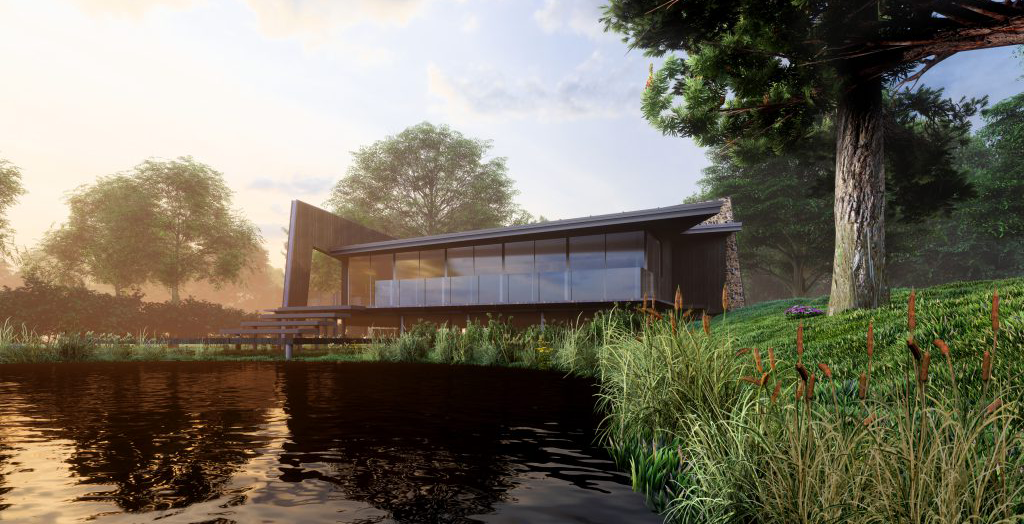
The proposed houses’ aesthetic takes inspiration from the local 20th-century modernism still present in the area.
Elevated, lightweight horizontal floating forms allow the light to penetrate through. The surrounding landscaping is being reflected in or seen through the large panes of glass reaffirming the subservience of the architecture to its natural context, and its harmony with the spatial setting.
The ability to see through and beyond the buildings highlights the design intention for the architecture not to compete with its surroundings, but to complement and enrich the environment.
Supported by the case officer and the conservation officer, these designs were applauded for their sensitive and careful design.
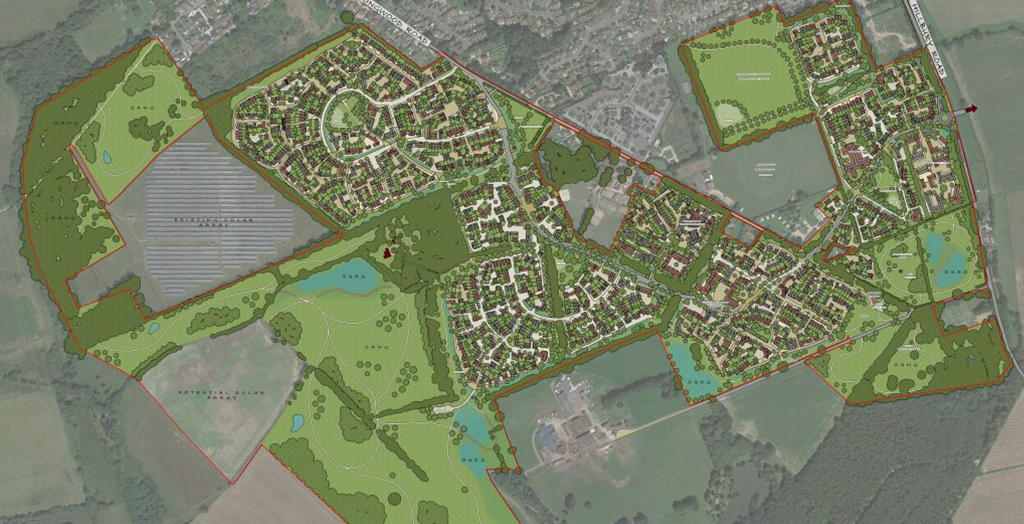
The Alderholt Meadows masterplan proposes four characterful and well-connected residential neighbourhoods, all within walking distance of a new mixed-use Local Centre and sitting within a rich matrix of public open space.
Sat to the South of the town of Alderholt, within Dorset, the masterplan seamlessly stitches into the existing setting.
This carefully considered design combines a full range of community facilities, meeting places and hubs that encourage social interaction. With a total of 1700 homes, the design is structured around a network of green corridors, that connect homes with amenities.
Forged into “pockets of place”, every journey and every facility present an opportunity for social interaction and function; creating sensations of ownership and community.
The Local Centre includes a Market Square, a local pub and a whole host of facilities. This hub sits within a matrix of journeys that connect with all neighbourhoods, and a rich tapestry of other community-driven heartlands, with access to open space resource for the whole village.
Along with a detailed master plan, SWA acted as lead urban designers and architects, managing all disciplines. This collaborative and united approach ensured that all design features, technical needs and BNG all merged into one holistic design.
Our input included design visions, an architectural design code and detailed designs for house types and key buildings.
The work on this project is ongoing and we look forward to this exciting scheme evolving further, with updates coming soon.
This full application is to NFDC for an allocated site (SS16) forming one of a whole range of sites, evolved, assessed, and included in their most recent and updated local plan, as a site suited for and allocated for housing.
From the onset a collaborative approach with NFDC was achieved and a design led creation seized and evolved.
A place that is varied and organic and which might connect with the existing settlement to create a new, enduring place that preserves a rural character at the fringe but, whose enjoyment, function and delight is one were landscape, architecture and place making all combine to offer a place that possesses narrative, serendipity and homes.
The submission is for 206 dwellings sat in low density with significant landscape and POS.
Scott Worsfold Associates Ltd., – Architects & Urban Designers, were elected to act as lead consultant in the evolution and final creation. We are indebted to the whole design team and the valued input of all, to fulfil the request by NFDC that an holistic design response should evolve and emerge. One where all factors combine and one where place making forms the heart of every aspect of how this new place might endure.
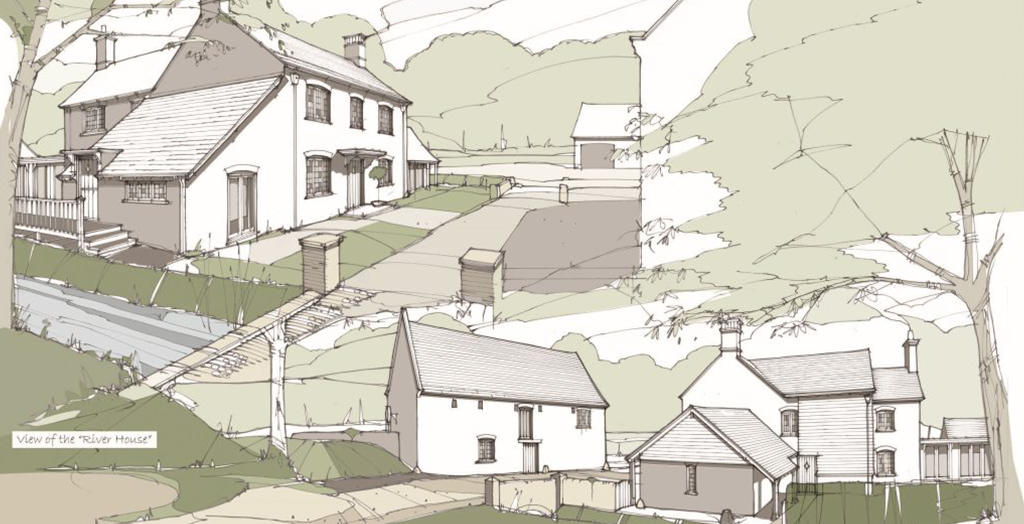
We were commissioned to asses the site and establish fresh and new ideas for how new homes could be planned, along with the conversion of the existing historic brick barns -all sat as one complex, within a characterful mews.
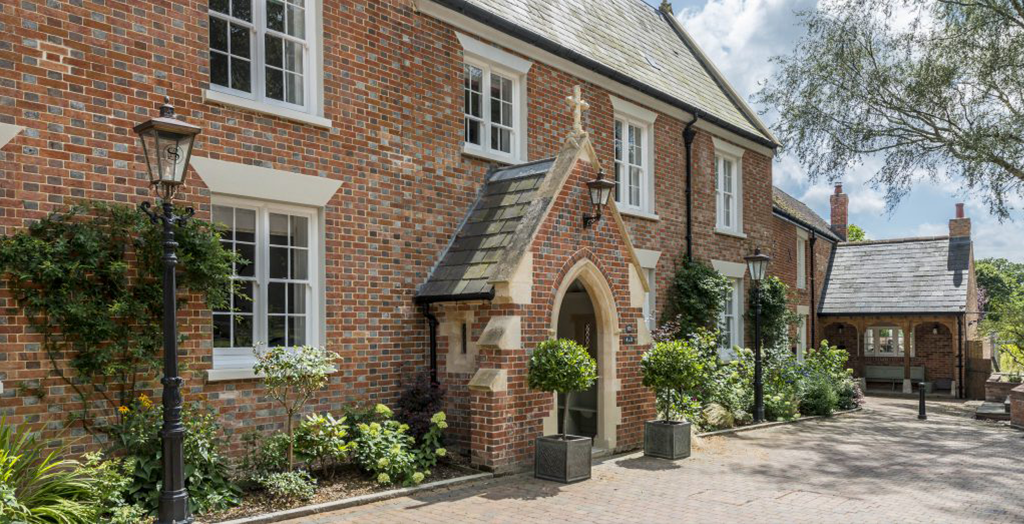
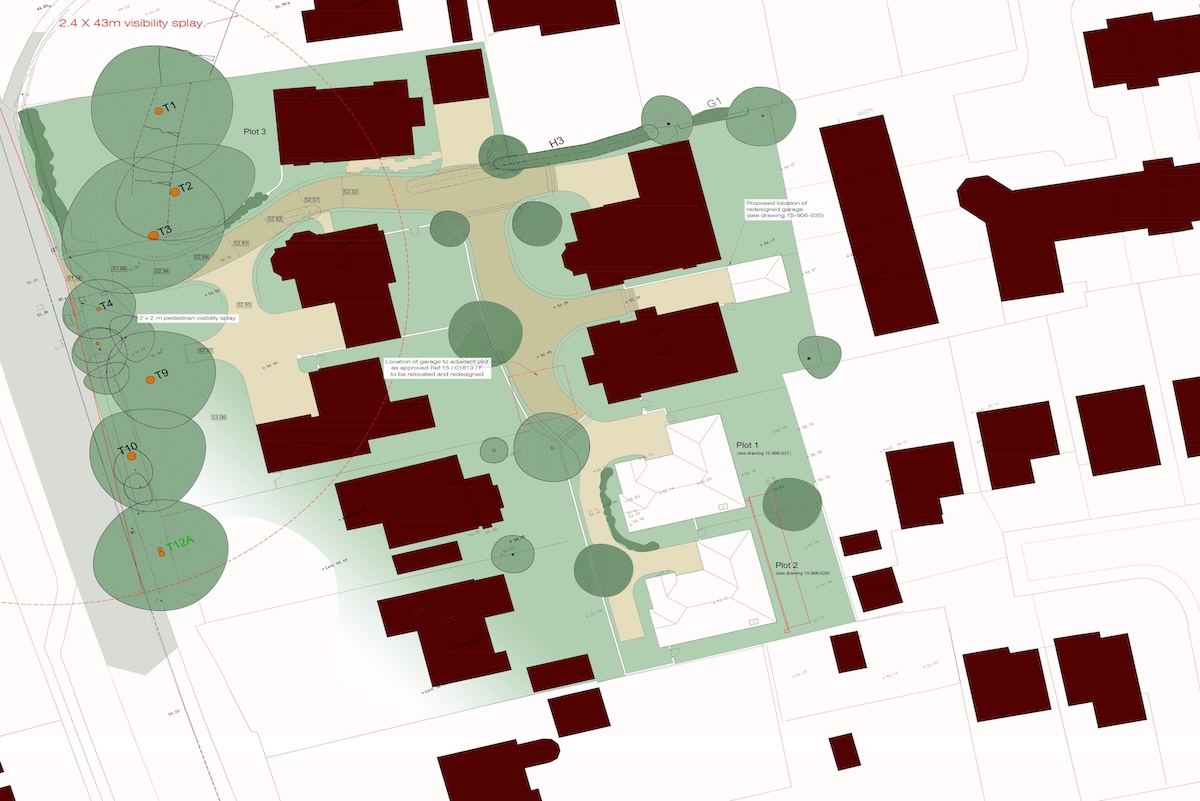
In the place of the refused house and bungalow, Scott Worsfold Associates designed 3 new beautiful townhouses. The existing barn forms were used, partially as garaging serving the new townhouses, or converted into additional homes and apartments, sat around a shared mews court.
Due to the quality of design and considered and skilful approach, permission was granted. Now built, our project is occupied enjoyed and seen as textbook solution to not just regeneration, but also design proposals that fit within the character and setting of its place.
The site was an exceptionally large plot with a single dwelling. The land parcel had a continuous frontage alongside the principal road, as well as an extensive garden, which extended into the back land.
With many established and mature protected trees, Scott Worsfold Associates produced a full and detailed design submission, working closely with an arboricultural consultant.
The scheme was exceptionally well received and, with little amendment, it passed to approval. Subsequently, additional adjacent land was negotiated by our Client and the initial design grew to include extra 2 homes.
Now all consented and built, our designs have been judged as exemplary and have been used within design codes and planning guidance for the area, as a reference and benchmark design standard.
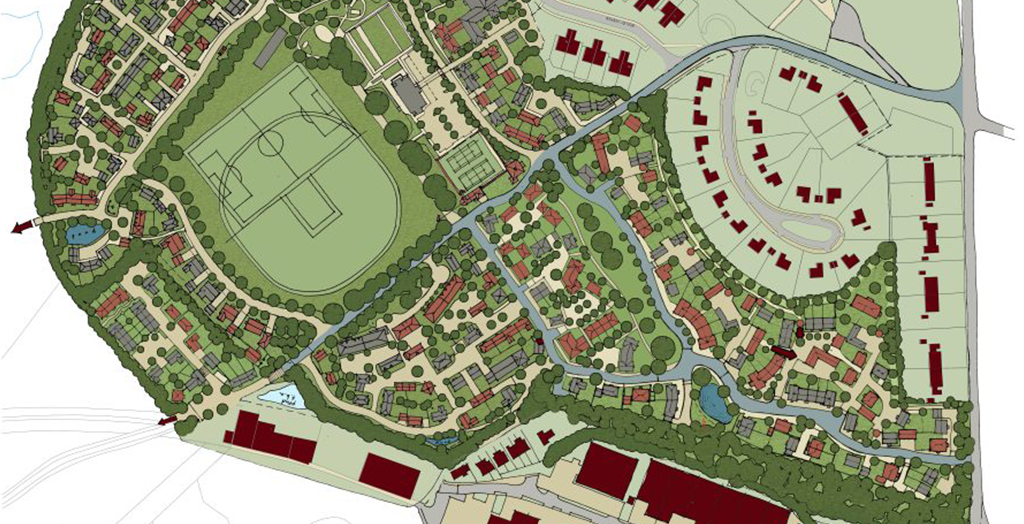
New homes sit in harmony with the narrative and setting of an access fed through the courtyard of the Mill & Farmhouse, and with a united approach to SUDS, landscape design and ecology.
The site lies within the Southeast Dorset Green Belt and outside of any settlement boundary. The site also falls within the Morden Conservation Area. The development area is immediately adjacent to the site of Morden Mill, which comprises of a listed mill and listed farmhouse complex.
The listed buildings on the site are considered to be of significant and national heritage importance.
The proposals are specifically required as essential enabling development in order to facilitate the restoration, refurbishment and renovation of the existing listed buildings complex, to preserve these important heritage assets.
This enabling development of 16 new homes has evolved in close consultation with Dorset County Council.
Significant arboricultural constraints had to be factored into the emerging designs, which were then fully detailed, submitted and approved by the Local Planning Authority.
After completion the LPA novated Aspects for a civic trust design award, resulting in a first place award as design that significantly contributed to the quality and character of the borough.
Subsequently, further land was agreed and the development grew to the west.
After completion, the whole project was novated for entry into the Dorset Architecture Awards where, it not only won best major development (first place), but overall show winner.
Significant arboricultural constraints had to be factored into the emerging designs, which were then fully detailed, submitted and approved by the Local Planning Authority.
After completion the LPA novated Aspects for a civic trust design award, resulting in a first place award as design that significantly contributed to the quality and character of the borough.
Subsequently, further land was agreed and the development grew to the west.
After completion, the whole project was novated for entry into the Dorset Architecture Awards where, it not only won best major development (first place), but overall show winner.